


Most of the difference between embroidered and woven patches comes down to the thread. Embroidery uses a thick thread that piles up into ridges, the kind you can catch with a fingernail. Weaving goes the other way. The thread is so thin that the patch feels almost like part of the shirt. Even small print you’d squint at on paper comes out readable. Price-wise, woven often comes in slightly lower. Embroidery, meanwhile, has more bulk and holds up better on gear that gets knocked around.
Your logo will usually make the decision for you. Got a tiny tagline, a hairline border, or your website printed under the icon? Woven will handle that. A chunky, simple mark, on the other hand, tends to look its best in thread you can feel. The item it’s going on and the number you need matter too.
In this guide, you’ll see how each patch is made and which jobs it handles well (and which it doesn’t). We’ll also cover what embroidered vs. woven patches cost and a simple way to decide.
What Is an Embroidered Patch?
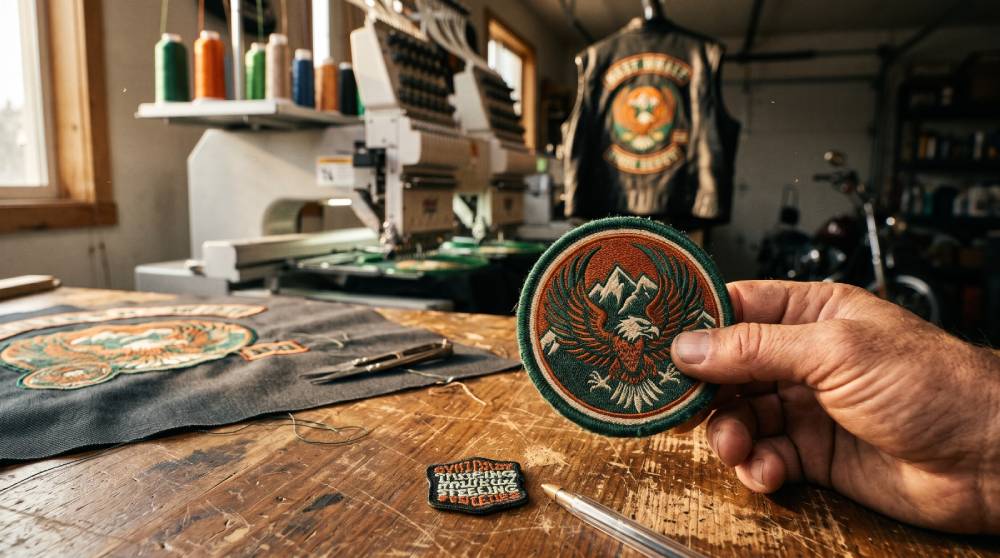
An embroidered patch is a piece of twill fabric with a design sewn on top in thick thread. Production starts with a sheet of twill big enough for several patches at once. Your artwork doesn’t go straight to the machine, though. A digitizer rebuilds it first as a stitch file. It’s detailed work, and a skilled digitizer is the difference between crisp lettering and uneven, bumpy text. Only after that does the needle start moving. On a typical 3-inch patch, that’s several thousand stitches before the design is fully covered.
Nobody invented embroidery recently. Archaeologists have found hand-stitched decoration on clothing that’s thousands of years old. A modern patch is machine-made, but it still works the same basic way: thread laid on top of cloth. Run your thumb over one, and you’ll notice the ridges right away. Round and square patches usually get a merrowed (overlocked) border, while custom die-cut shapes get a satin-stitch edge.
Look at the patches on a firefighter’s jacket or a biker’s vest, and you’ll notice nearly all of them are stitched. That raised, solid look is the reason embroidery patches remain the standard for vests, varsity jackets, and uniforms.
The catch is detail. Embroidery thread is fairly thick, and there’s only so much it can do at a small scale. Letters that are too tiny tend to close up, and thin lines can turn into a fuzzy blur.
What Is a Woven Patch?
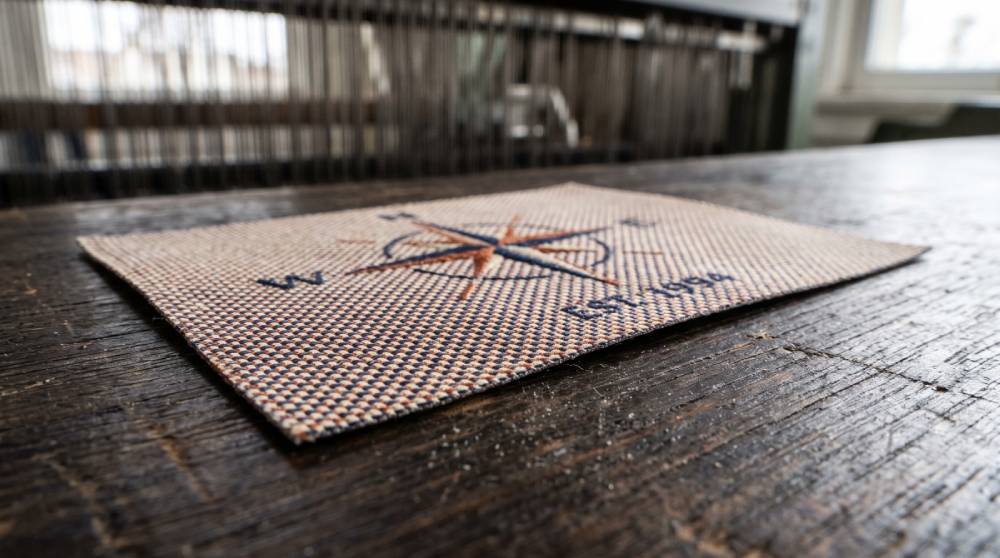
Woven patches skip the embroidery machine entirely and come off a loom instead. Thin threads are woven together so the design becomes part of the fabric. There’s no separate backing with stitches sitting on top.
The loom uses a Jacquard machine, which can lift each lengthwise (warp) thread on its own. Older looms raised threads in big groups, so this level of control was a huge step forward. It lets the loom place thread almost as precisely as a printer places ink. That’s why woven patches can hold detail embroidery can’t. If you’re curious, the Science Museum Group’s collection has a hand-operated Jacquard loom from around 1910.
Because the thread is so fine, woven patches come out thin, light, and flexible. They’re smooth to the touch, and even tiny parts of a design keep crisp edges.
Ask anyone to describe woven patch texture, and they’ll probably say “flat.” That isn’t a bad thing. On a shirt or a cap, it looks almost like part of the fabric. That suits brands going for a clean, minimal style. If you’d rather have a patch that pops off a jacket, though, embroidery still does that better.
Embroidered vs Woven Patches: Key Differences at a Glance

| Feature | Embroidered Patch | Woven Patch |
| Construction | Thread stitched onto a twill backing | Design woven into the fabric on a loom |
| Thread thickness | Thick embroidery thread | Fine, thin weaving thread |
| Surface texture | Raised, ridged, easy to feel | Flat and smooth, very little raised surface |
| Detail capability | Moderate: bold shapes and large text | High: small text and thin lines |
| Color handling | Solid blocks; limited blending | Many colors; smoother color changes |
| Thickness & weight | Thicker, stiffer, heavier | Thin, light, flexible |
| Feel against skin | Firmer, can feel scratchy | Softer, moves with the fabric |
| Style | Classic, heritage, rugged | Modern, clean, technical |
| Typical cost | $1–$5+ per patch | $0.90–$4+ per patch |
| Best suited to | Jackets, caps, vests, uniforms | Detailed logos, small text, labels |
Neither type wins every category. Which one you should pick really comes down to what’s in your artwork, so let’s look at that next.
Detail & Design Limits: Which Handles Small Text Better?
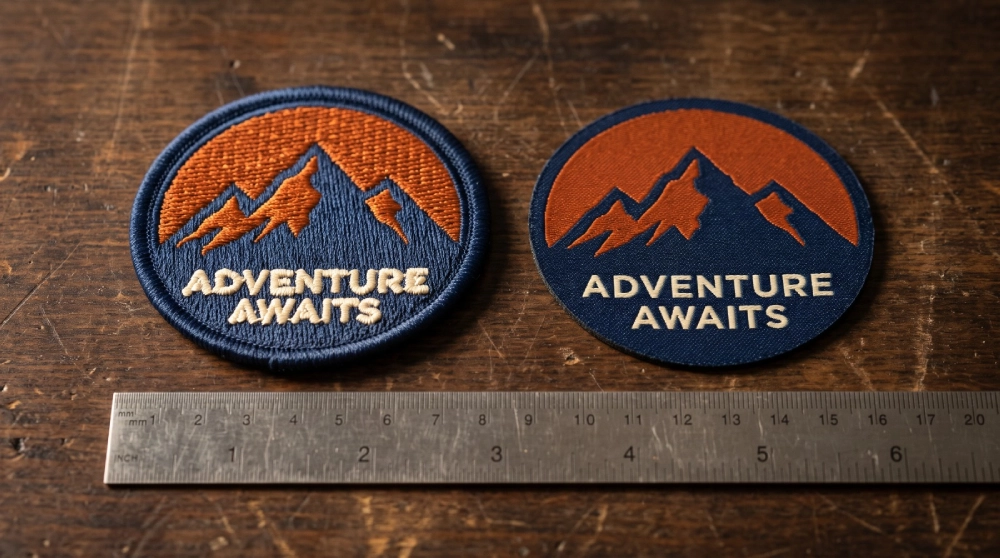
If you’re torn between woven vs embroidered patches, look at the smallest text in your logo first. A design that looks perfect on your screen can lose its tagline completely once it’s stitched at 3 inches wide.
It’s a bit like writing with a marker versus a fine-point pen. With the marker (embroidery), you have to write big, or the letters smudge together. Weaving is the fine-point pen. You can shrink your text to roughly half the size, and people can still read it.
| Design element | Embroidered Patch | Woven Patch |
| Minimum readable letter height | About 0.25″ (6 mm) | About 0.12″ (3 mm) |
| Thinnest reliable line | About 0.04″ (1 mm) | About 0.02″ (0.5 mm) |
| Practical color count | 6–9 thread colors | 8–12+ colors |
| Gradients & shading | Poor: must be simplified into solid blocks | Fair: some fine blending possible |
| Photo detail | Not suitable | Not suitable (use printed or sublimated) |
| Fine outlines & serifs | Often lost or thickened | Usually held |
| Large solid color areas | Excellent | Good, but can look flat |
| Typical maximum size | Up to back-patch size | Best at small to medium sizes |
Does your logo have a web address, a ® symbol, a date, or any text under a quarter inch tall? Then woven is probably the safer bet. If it’s a bold mark with chunky lettering, go with embroidery. A simple shape with some depth to it just looks better on a jacket, and woven can’t give you that depth.
Quick check before you order: Print your logo at its actual patch size, tape it up somewhere, and walk across the room. Turn around. If the small words are a struggle to make out, they’ll be worse in thread. That’s a sign to switch to woven or bump up the font size.
Size plays a big part here too. Our custom patch size guide covers how the dimensions you choose affect which details make it through production.
Durability, Feel and Where Each One Fails
Made well, either type will last for years. What changes is how they age, and that’s worth knowing before you order a few hundred.
Where embroidered patches perform best: Heavy thread on twill shrugs off a lot of friction. A mechanic’s jacket, for example, rubs against car doors, tool chests, and seat backs every shift. Embroidery can take that. And if it does get a little scuffed, the raised texture hides it well.
Where embroidered patches fall short: Long stitches can catch on things and get pulled. A densely stitched patch is also stiff, which isn’t great on stretchy fabric or thin athletic wear. After a lot of washes, you may notice some fuzz around the edges.
Where woven patches perform best: Since nothing sticks up from the surface, there’s not much to snag. Woven patches stay flat, don’t curl, and won’t fuzz the way embroidery sometimes does. They’re also a better fit for lightweight shirts, soft performance caps, and the inside of collars. They bend with the fabric instead of fighting it.
Where woven patches fall short: That flat surface can make them easy to overlook. Put one on a thick leather vest or a heavy canvas jacket, and it may look more like a clothing label than a badge. Dirt tends to show more, too, since there’s no texture to hide it.
It’s also worth thinking about who’s going to see the patch. Ask most people to picture a patch, and they’ll describe something like a scout badge or a military emblem. Those are embroidered. Woven patches can show finer detail, but they don’t carry the same weight. Go with the look you’re after, not just the better spec sheet.
Embroidered vs Woven Patch Cost
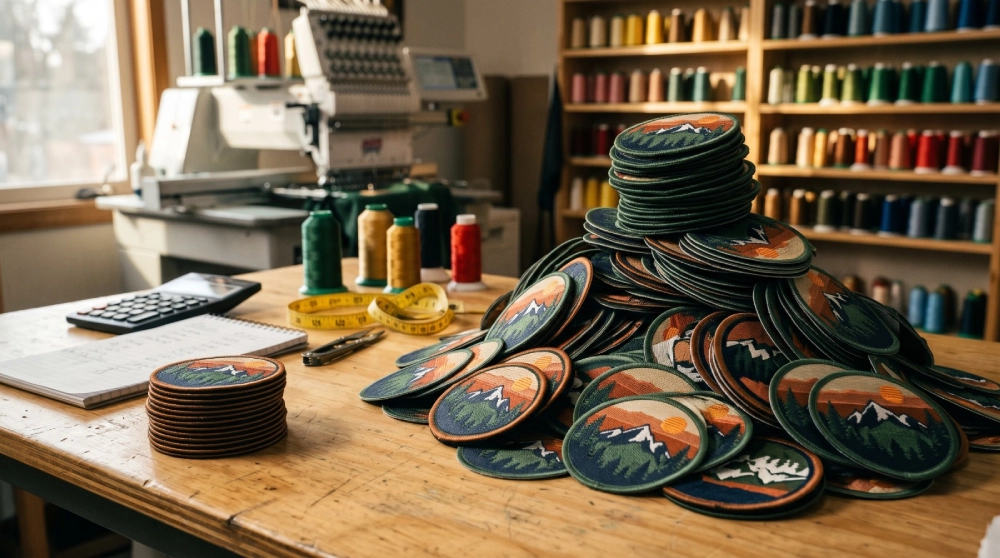
Both types are priced using the same factors: size, quantity, number of colors, backing, and edge finish. The type of patch actually matters less than most people think. Size and quantity move the price a lot more.
| Patch type | Estimated cost per patch | What raises the cost | What lowers the cost |
| Embroidered | $1–$5+ | Dense stitching, large size, 3D puff, metallic thread | Simpler artwork, merrowed edge, higher quantity |
| Woven | $0.90–$4+ | Very fine detail, many colors, laser-cut custom shapes | Standard shapes, smaller size, higher quantity |
| Both | Varies | Velcro backing, individual bagging, rush orders | Standard iron-on or sew-on backing, bulk orders |
Woven patches often come in a little cheaper at the same size. Embroidery is priced partly on stitch count, so a busy design costs more. Woven pricing is based mostly on size. On a small order, though, the difference is so small that it shouldn’t be what decides it for you. Pick the type that suits your design, then order enough to bring the per-patch price down.
Quantity is where you’ll see the biggest savings. Setup costs get split across the whole order, so 500 patches cost far less per piece than 25. You can see how that works on our bulk custom patch page, and our custom patch cost guide goes through every price factor in more depth.
Embroidered or Woven: Which Patch Should You Choose?
Best patch type by garment and use
| Use case | Recommended type | Suggested backing | Why |
| Caps and structured hats | Embroidered (or 3D puff) | Sew-on | Raised texture is easy to see on a small front panel |
| Varsity and letterman jackets | Embroidered or chenille | Sew-on | Classic look; the patch needs to stand out |
| Biker vests and back patches | Embroidered | Sew-on | Handles heavy wear and fits the traditional look |
| Workwear and uniforms | Embroidered | Sew-on or Velcro | Holds up to rubbing and industrial washing |
| Fashion brand labels | Woven | Sew-on | Thin and soft, so it won’t irritate the skin |
| Logos with small text or a URL | Woven | Iron-on or sew-on | Keeps small text clear and readable |
| Tactical gear and morale patches | Either | Hook and loop | Easy to swap; choose based on artwork detail |
| Sportswear and performance fabric | Woven | Sew-on or low-temperature heat seal | Flat and flexible; test heat on synthetic fabric first |
| Bags, backpacks, outerwear | Embroidered | Sew-on | Bold, visible and handles weather and friction |
Can’t decide? Order one sample of each with your own artwork. A single sample costs a fraction of a full order, and holding both in your hand usually makes the answer obvious.
Backing Options for Embroidered and Woven Patches
The backing you choose has nothing to do with the patch type. Embroidered and woven patches can both use any of these:
- Sew-on: The most secure option. If the item gets washed a lot, use this one.
- Iron-on (heat seal): Fast, with no sewing needed. Skip it for leather, nylon, or anything that can’t handle heat.
- Hook and loop (Velcro): Easy to take off and swap. You’ll see it on most tactical gear and uniforms.
- Adhesive (peel-and-stick): Meant for short-term use, like events and promotions.
Trying to decide between the first two? Our iron-on vs. sew-on patches guide breaks down how long each one lasts. For patches you want to swap out, check out our guide to hook-and-loop patches.
How to Order Embroidered or Woven Patches
Whether you go embroidered or woven, here’s what happens after you reach out:
- Send your artwork: An AI, EPS, or PDF vector file is ideal. Don’t have one? A sharp PNG or JPG is usually enough to start. Tell us the size you’re after and, if your brand uses them, your Pantone codes.
- Review the digital proof: You’ll usually get it within 1–2 business days. If any text is too small, we’ll point it out here, and that often settles the embroidered-or-woven question on its own.
- Approve a physical sample (optional): This takes 1–3 business days. It’s worth doing on a first order or a big run.
- Production: Standard production is 5–7 business days. Need it faster? Rush production in 24–72 hours is available on qualifying orders.
- Delivery: Shipping within the US takes 2–5 business days.
At Patches Studio, we make both custom embroidered patches and custom woven patches, with no minimum order. That means you can try one of each before you commit to a full run. Looking for woven labels instead? Head over to our labels and tags page.
Conclusion: Embroidered vs Woven Patches
There’s no single winner in the embroidered vs woven patches debate. A biker club ordering back patches and a clothing brand ordering neck labels need very different things, and that’s fine.
Is your logo bold and headed for a work jacket, a cap, or a vest? Then embroidered patches are the safer choice. Small lettering, thin lines, or a soft, stretchy shirt? That’s where woven patches earn their place. Not sure yet? Order a sample of each. Then send your artwork to Patches Studio, and we’ll come back with a free quote and a digital proof, so you can compare before you spend more.
Frequently Asked Questions
What is the difference between woven and embroidered patches?
An embroidered patch is fabric with thread sewn over it. Weaving builds the design into the fabric itself, on a loom, using thread that’s a lot thinner. Close your eyes and run a finger over each, and you could still tell them apart: one’s bumpy, one’s nearly smooth. That thin weaving thread is also why a woven patch can carry fine print an embroidered one would smear.
Are woven patches cheaper than embroidered patches?
A little, yes. Embroidery pricing climbs with stitch count, and a logo that’s packed edge to edge with thread can cost noticeably more. Woven pricing mostly follows the size of the patch. You’re looking at roughly $0.90 to $4+ for woven and $1 to $5+ for embroidered. Order size matters more than either. Three hundred patches cost a lot less each than thirty, whichever type you go with.
Which lasts longer, woven or embroidered?
Neither one is fragile. Where they differ is the kind of wear they handle. If the patch is going on a work jacket that gets dragged across tailgates, embroidery is the tougher pick. Woven makes more sense on a light tee or a school polo that goes through the washer twice a week. Nothing sticks up, so nothing frays.
Can woven patches handle small text and thin lines?
Yes. Small text is woven’s strong point. Letters down to about an eighth of an inch tall stay easy to read, which is roughly half of what embroidery needs. Taglines, web addresses, the little ® next to a brand name, thin serif fonts: woven keeps all of these readable. Embroidery often blurs details that are small or drops them completely.
How are woven patches made?
They’re made on a Jacquard loom, which controls each lengthwise thread one by one. Your design gets woven in as the cloth is being made, line by line, so there’s no stitching step afterward. Once the sheet comes off the loom, the patches are cut out (die-cut, laser-cut or finished with a merrowed border). Backing is the last thing added.
Do woven patches feel different from embroidered ones?
Definitely. Hold one of each, and you’ll notice it in seconds. The embroidered one is stiff and a bit bumpy, with stitches you can trace. The woven one feels closer to a heavy clothing tag, smooth and flexible. On a gym shirt or anywhere the fabric stretches, you’ll appreciate that. Want something with some weight that feels like a proper badge? Pick embroidered.
Which is better for hats and caps?
For the front of a structured cap, embroidered patches are the most common choice. The raised stitching is easy to see, even on a small patch. Woven works well on performance caps, five-panel hats, and logos with a lot of fine detail. We cover placement and sizing in our custom patches for hats guide.
Which is better for biker vests and back patches?
Embroidered, nearly every time. Back patches are big; they’re supposed to look bold, and they rub against seats and jackets constantly. Thick thread handles that kind of wear and fits the classic biker style. A flat woven back patch can end up looking like a label. Sew-on backing is the standard here.
Can I get iron-on or sew-on backing on either type?
Yes. Backing is added once the patch itself is finished, so the patch type doesn’t limit you. Sew-on, iron-on, hook and loop (Velcro), and adhesive all work on both, and your fabric is what should decide it. Sew-on is best for leather, nylon, and anything washed often. Iron-on works for cotton and everyday clothing, and Velcro makes sense if you’ll be swapping patches.
How much do embroidered patches cost per piece?
Most land somewhere between $1 and $5+ each. Where yours falls depends on size, quantity, stitch density, thread type, and backing. A small 2-inch patch ordered in the hundreds will sit near the bottom of that range. A big, detailed back patch in a batch of 25 will cost more. For an exact number, request a free quote with your size and quantity.
Is there a minimum order for woven patches?
No, there’s no minimum at Patches Studio. You can order a single woven patch, or one of each type if you’re still comparing. Seeing your own logo in both styles makes the choice a lot easier. Just keep in mind that bigger orders still bring the price per patch down.
What’s the difference between printed and embroidered patches?
Printed patches are made by transferring ink or dye onto fabric. Because of this, they can show gradients, photos, and almost any number of colors. Embroidered patches use thread instead. That gives them a raised, premium feel, but they work best with a handful of solid colors. Go printed for full-color artwork, and choose embroidered when texture and durability matter more.
Which type is better for a complex logo with gradients?
Neither one is great with gradients. Woven can manage smoother color changes than embroidery. Still, both use thread, so colors show up as separate blocks instead of a smooth blend. For real gradients or photo-like images, sublimated or printed patches are a better fit. If you’d rather stick with thread, simplify your artwork into solid colors first. Our types of patches guide walks through every option.
How long does production take for each type?
About the same for both. Artwork approval usually takes 1–2 business days, and an optional sample adds another 1–3. Once you approve the proof, standard production takes 5–7 business days. In a hurry? Rush production in 24–72 hours is available on qualifying orders. Shipping within the US adds 2–5 business days.