


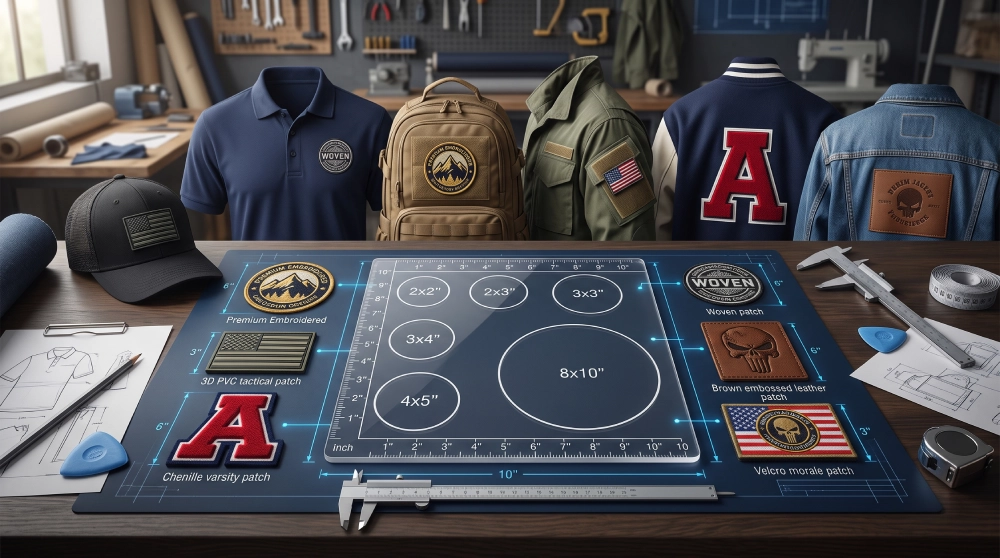
Size is important when ordering custom patches. The custom patch size will affect the clarity of the design, legibility of any text, durability, location, cost of production, and appearance. If the patch is too small, it may be hard to see the logos and text. The patch may be too large for the clothing or the area it is to be applied to.
Choosing the right size embroidered patches for employee uniforms, PVC patches for tactical gear, chenille patches for varsity jackets, or leather patches for branded headgear from Patches Studio will keep your design looking professional and lasting.
It’s a guide to the standard sizes for all major patch types, garment placements, and uses. Before you place your order, you’ll learn how to measure for the best fit and avoid common sizing problems.
The Importance of Choosing the Correct Patch Size
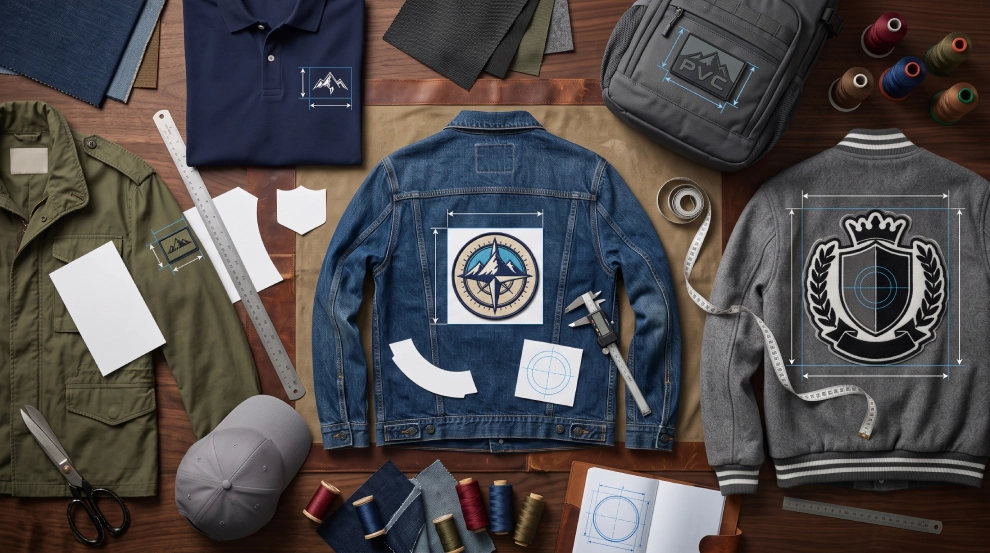
A custom patch should enhance a garment, not overpower it. The ideal size depends on four key factors:
- Patch type: Embroidered, woven, PVC, chenille, leather, and Velcro patches all have different production characteristics.
- Garment placement: A sleeve has far less available space than the back of a jacket.
- Complexity of the art: logos and fine text with lots of details need bigger sizes.
The size you can use depends on the type of backing, e.g., sew-on, iron-on, or hook-and-loop.
Choosing the right custom patch size helps ensure
- Legibility of the text
- Logos and pictures are highly loved.
- Clothes fit well.
- Extended application period
- Lesser production change
Custom Patch Size Chart Standard Sizes At a Glance
These are the most common patch sizes ordered and what they are used for.
| Patch Size | Common Applications |
| 1 × 1 | Small icons, lapels, promotional items |
| 2 × 2 | Hats, sleeves, small logos |
| 2 × 3 | Morale patches, tactical gear, name patches |
| 3 × 3 | Left chest logos, club patches |
| 3 × 4 | Uniform patches, shoulder patches |
| 4 × 5 | Bags, jackets, promotional patches |
| 6 × 8 | Small jacket back patches |
| 8 × 10 | Full jacket back designs |
| 10 × 12+ | Oversized custom back patches |
Pro Tip: Standard sizes usually reduce production time because manufacturers already have templates for these dimensions.
Custom Patch Size Guide by Patch Type
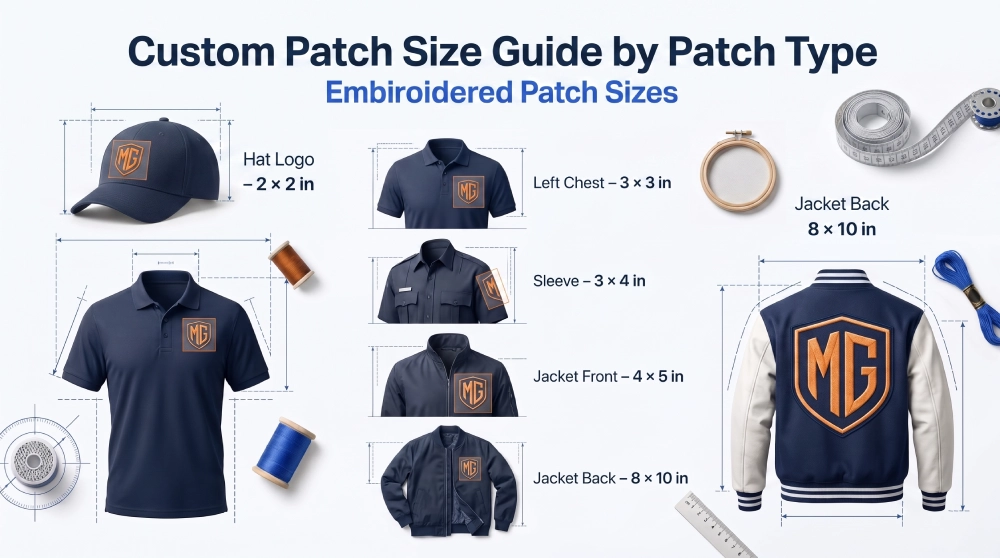
Embroidered Patch Sizes
Embroidered patches remain the most popular choice because of their classic appearance and durability. They can be produced in almost any size, but most orders fall between 2 × 3 inches and 4 × 5 inches.
| Application | Recommended Size |
| Hat logo | 2 × 2 |
Left chest | 3 × 3 |
| Sleeve | 3 × 4 |
| Jacket front | 4 × 5 |
| Jacket back | 8 × 10 |
If your design has small lettering or fine detail, make the patch larger so the stitches will be easy to see. Embroidery of standard text should be at least ¼ inch in height for legibility.
Woven Patch Sizes
Woven patches are perfect for logos, maps, and small writing since they use finer threads than embroidery. They may show rich artwork in smaller sizes without raised stitching.
| Recommended Sizes | Best For |
| 1.5 × 2 in. | Small labels |
| 2 × 3 in. | Uniform logos |
| 2.5 × 3.5 in. | Detailed branding |
| 3 × 4 in. | Promotional patches |
A woven patch measuring 2 × 3 inches often provides the same level of visual detail as a 3 × 4-inch embroidered patch.
PVC / Rubber Patch Sizes
PVC patches are waterproof, flexible, and extremely durable, making them popular for military, outdoor, and tactical applications.
| Shape Standard | Size |
| Square | 2 × 2 |
| Rectangle | 2 × 3 |
| Round | 2–4 in. diameter |
| Custom Shape | 2–4 |
Unlike embroidered patches, PVC designs rely on molded layers rather than thread, allowing them to reproduce sharp lines even at smaller sizes.
Iron-On Patch Sizes
Iron-on patches are available in many of the same dimensions as embroidered patches. However, size plays a major role in how securely the adhesive bonds to fabric.
| Patch Size | Recommended Use |
| Up to 3 × 4 in. | Excellent adhesion |
| 4 × 5 in. | Good with careful application |
| Larger than 4 × 5 in. | Sew around the border after ironing. |
Pro Tip: For iron-on patches larger than 4 × 5 inches, always reinforce the edges with perimeter stitching. This prevents it from flaking off after a few washes.
Chenille Patches Sizes
Chenille patches are thick, fuzzy, and are commonly seen on varsity jackets and athletic wear.
| Application | Recommended Size |
| Varsity Letter | 3 × 4 |
| Mascot Logo | 4 × 5 |
| Jacket Back | 8 × 10 |
Because chenille relies on thick yarn, patches smaller than 2 × 2 inches often lose their distinctive texture.
Velcro Hook-and-Loop Patch Sizes
Velcro-backed patches are widely used for military uniforms, tactical gear, law enforcement, and outdoor equipment.
| Common Size | Typical Use |
| 2 × 2 in. | Helmet patches |
| 2 × 3 in. | Morale patches |
| 3 × 4 in. | Shoulder panels |
The 2 × 3-inch format remains the most popular size because it fits standard tactical loop panels and MOLLE-compatible gear.
Leather Patch Sizes
Leather patches are commonly applied to hats, backpacks, jeans, and workwear. Since leather is heavier than fabric, smaller sizes generally provide the best balance between durability and comfort.
| Application | Recommended Size |
| Hat | 2 × 3 |
| Backpack | 3 × 4 |
| Jeans | 2 × 3 |
| Workwear | 3 × 4 |
Laser engraving and embossing allow leather patches to retain crisp detail even at relatively compact sizes.
Patch Sizes by Garment and Placement
Even the perfect patch can look out of place if it’s the wrong size for the garment. Below are the most common placement recommendations.
| Garment Placement | Ideal Size |
| Left Chest | 3 × 3 |
| Upper Sleeve | 3 × 4 |
| Hat Front | 2 × 3 |
| Backpack | 4 × 5 |
| Shirt Back | 7 × 9 |
| Jacket Back | 8 × 10 |
These measurements provide a balanced appearance on most adult garments while leaving enough clearance around seams and edges.
Custom Patch Size Guide for Different Applications
These measurements give most adult clothes a balanced look while still leaving enough space around the seams and edges. Custom Patch Size Chart for Different
Applications: Different companies and organizations tend to have standard sizes for custom patches. Properly sizing these will ensure that the patch will fit the garment, be within all regulations, and look professional.
Military Patches Size
They use military patches for rank and ID. While the sizes may differ from branch to branch and from country to country, these are the most common sizes used in the U.S. style military uniforms.
| Military Patch Type | Standard Size |
| Unit Shoulder Patch | 2.5 × 2.5 |
| Name Tape | 1 × 4 |
| Branch Tape | 1 × 4.5 |
| U.S. Flag Patch | 2 × 3.5 |
| Rank Patch | Varies by rank and uniform. |
Always check your organization’s uniform regulations before ordering military patches, as some agencies require specific dimensions and placement.
Morale Patch Sizes
Morale patches are popular among military personnel, law enforcement, airsoft teams, and outdoor enthusiasts. They are typically attached with hook-and-loop backing and designed to fit standard tactical panels.
| Morale Patch Style | Recommended Size |
| Square | 2 × 2 |
| Rectangle | 2 × 3 |
| Large Morale Patch | 3 × 4 |
| Helmet Patch | 2 × 2 |
The 2 × 3-inch size remains the industry standard because it fits most tactical backpacks, plate carriers, and chest rigs.
Sports Team Patch Sizes
Sports patches appear on jerseys, warm-up jackets, duffel bags, and commemorative apparel.
| Sports Application | Recommended Size |
| Jersey Chest Logo | 3 × 3 |
| Sleeve Patch | 2.5 × 3 |
| Team Jacket Chest | 3 × 4 |
| Jacket Back Logo | 8 × 10 |
| Championship Patch | 4 × 5 |
For league-approved uniforms, always verify sizing requirements before placing a bulk order.
Uniform Patch Sizes
Businesses, schools, security companies, and public service organizations commonly use uniform patches for branding and identification.
| Uniform Type | Common Patch Size |
| Company Logo | 3 × 3 |
| Security Patch | 3 × 4 |
| Fire Department | 4 × 4 |
| EMS Patch | 3 × 4 |
| School Patch | 3 × 3 |
These sizes offer a clean, professional appearance while maintaining readability from a distance.
Name Tape and Name Patch Sizes
Name patches are among the most standardized patch formats because they must fit designated areas above shirt pockets or on tactical uniforms.
| Name Patch Type | Standard Size |
| Military Name Tape | 1 × 4 |
| Uniform Name Patch | 1 × 4.5 |
| Woven Name Label | 0.75 × 4 |
| Embroidered Name Patch | 1.25 × 4.5 |
For embroidered name patches, keep lettering large enough to remain readable after stitching.
Custom Patch Size: Fabric and Backing Matter
Choosing the right Custom Patch Size also depends upon the type of fabric and how it will be backed.
The Role of Thread Count and Embroidery Fill Percentage
The detail that can be put into a patch depends on the density of the embroidery.
- Dense embroidery requires a larger patch.
- Small patches work best with simple artwork.
- Thin lines and tiny lettering should be enlarged for better stitch quality.
As a rule, increasing your patch dimensions by half an inch can significantly improve detail reproduction on intricate designs.
Backing Options and Their Sizing Implications
| Backing Type | Best Size Range |
| Sew-On | Any size |
| Iron-On | Up to 4 × 5 |
| Velcro Hook-and-Loop | Match loop panel size |
| Peel-and-Stick | Under 3 × 3 |
| Heat Press | Up to 6 × 6 |
Larger patches generally work better with sew-on backing, because the stitching gives more long-term durability.
How to Measure and Select the Proper Size for a Custom Patch
Measuring before you purchase will help to take the guesswork out of it and reduce the chances of getting a patch that doesn’t fit your item.
Step-by-Step Guide to Measuring for a Custom Patch
- Determine the exact location of the patch.
- Measure the width and height available using a ruler or measuring tape.
- Leave at least ¾ to 1 inch of clearance from seams, pockets, collars, or zippers.
- Compare your measurements with standard patch sizes.
- Print a paper template and tape it to the garment to check the look.
- Please ask for a digital proof before we start production.
By doing the above steps, you can be guaranteed that your custom patch size will match your design and garment.
Common Patch Sizing Mistakes to Avoid
Many ordering problems can be avoided with a little planning.
Avoid these common mistakes:
- Ordering the smallest size to reduce cost.
- Choosing a size before measuring the garment.
- Ignoring the amount of detail in the artwork.
- Placing patches too close to seams or pockets.
- Forgetting to account for curved surfaces like hats.
- Skipping the approval of a digital proof.
Taking a few extra minutes to review your measurements can prevent costly reorders.
Design Tips to Get the Most From Any Custom Patch Size
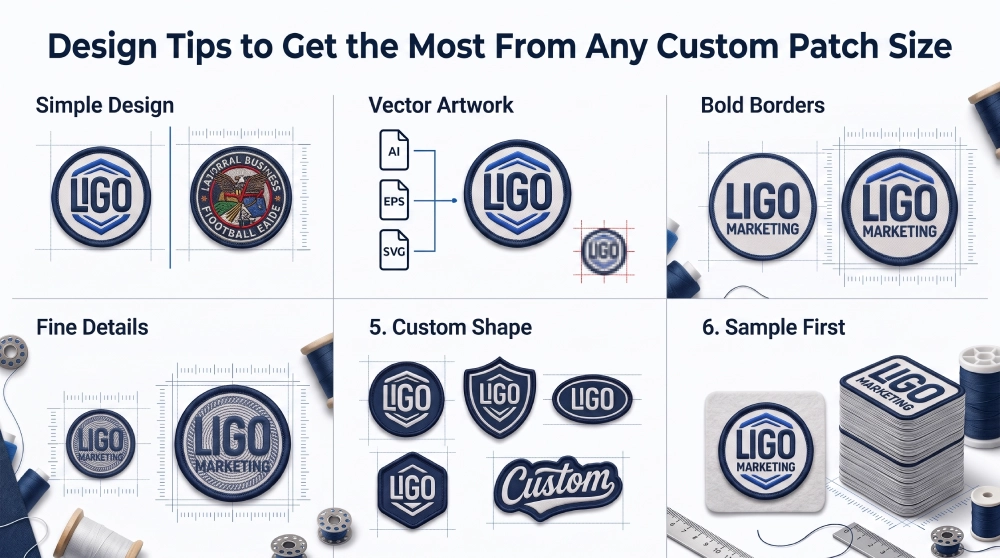
A well-designed patch makes the most of the available space. These simple design practices help achieve the best results:
- Keep artwork simple on patches smaller than 2 inches.
- Use vector files (AI, EPS, or SVG) whenever possible.
- Increase the patch size if your design contains fine text.
- Select thick outlines for increased visibility.
- Match the patch shape to the logo instead of forcing it into a standard rectangle.
- Order a sample before going for a large production order.
Final Thoughts
Selecting the right size custom patch is essential to get that professional look that will last and look good on your skin. It all depends on your design, the type of patch, where you want to put it on the garment, and what backing you go with. A digital proof will allow you to measure and double-check the proof carefully before production. This will prevent errors in sizes and ensure that your design is clear and appealing to the eye.
If you need patches for outfits, hats, jackets, or tactical gear, Patches Studio will help you pick the right size from the get-go for the best look, function, and long-haul performance.
Common Questions
What is the standard size for a custom patch?
The most popular size for custom patches is 2 x 3 or 3 x 4. Size will depend on the individual artwork, the patch type, and the location.
What size patch goes on a sleeve?
Most sleeve patches measure between 2.5 × 3 inches and 3.5 × 4 inches. This range allows visibility to everyone while maintaining a good balance on the different sleeve widths.
How big should a back patch be on a jacket?
Normal back patches for jackets vary from 8 x 10 inches to 10 x 12 inches. Bigger designs need to be carefully measured to ensure they fit and look right.
What is the standard morale patch size?
The standard morale patch size is 2 × 3 inches. This popular format fits most tactical gear, Velcro panels, backpacks, and other outdoor equipment applications.
What size are military uniform patches?
Military uniform patches vary by purpose, but shoulder patches are commonly 2.5 × 2.5 inches. Name tapes usually follow a standard 1 × 4-inch format.
What size patch fits on a baseball cap?
A 2 × 3-inch patch fits most structured baseball caps comfortably. Smaller patches may work better for curved surfaces or hats with less room on the front panel.
How do I measure for a custom patch?
Check the space available for location. Consider seam clearance and compare the dimensions to standard sizes. If you make a paper template, you can see what the finished patch will look like.
What is the minimum size for an embroidered patch?
Embroidered patches can be as small as 1 x 1 inch or so, but that is the smallest practical size. Complex designs usually need to be 2 x 2 inches minimum.
Can a patch be too big for a garment?
Yes, very large patches can swamp the garment, distort lightweight fabrics, and create application issues. Always select a size that matches the available placement area.
What is the most popular custom patch size ordered in the U.S.?
The most popular custom patch sizes are 2 x 3 inches, 3 x 3 inches, and 3 x 4 inches. These dimensions suit many common applications.
What size patch do you put on a sports jersey?
Sports Jersey Patches are generally 3 x 3 inches to 4 x 4 inches. Final size will vary depending on team requirements, logo design, and placement.
What is the standard size for a PVC morale patch?
A 2 x 3 inch PVC morale patch is the most popular size. Velcro panels and a broad range of outdoor gear applications. Designed for tactical gear.