


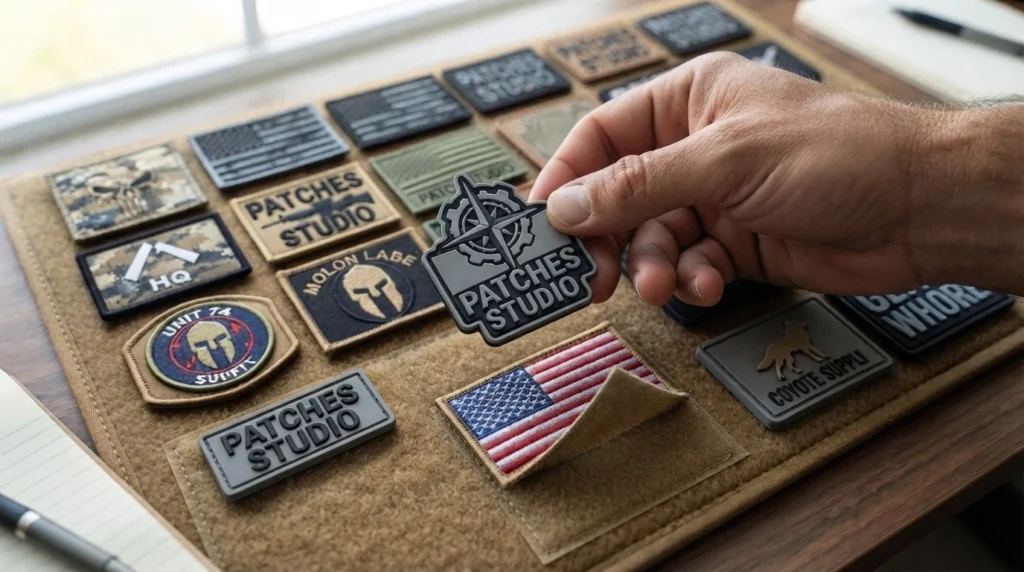
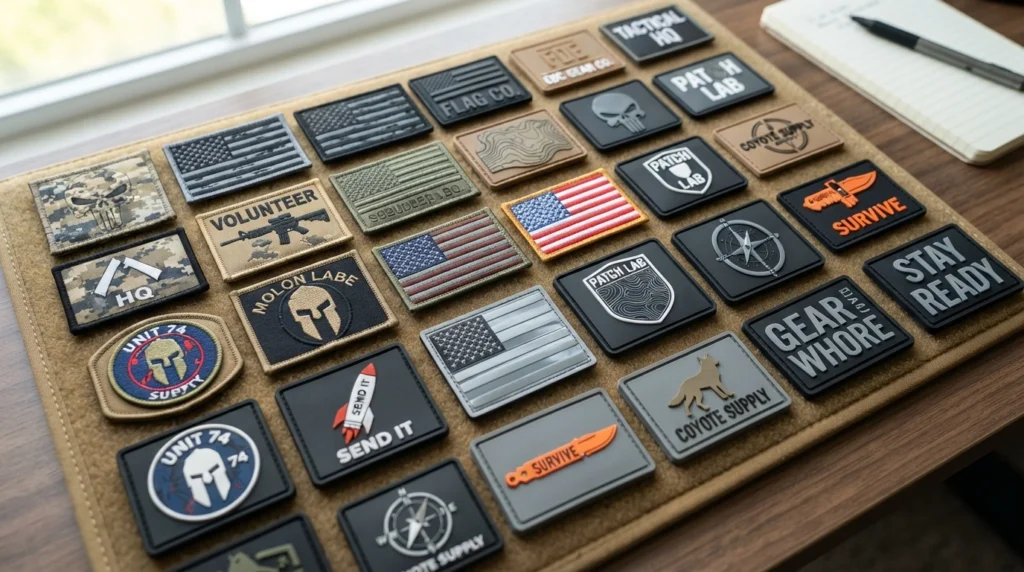
You’ve seen them everywhere on a soldier’s vest, a kid’s backpack, a barista’s hat, even a service dog’s harness. Press on, pull off, swap for something new. It looks effortless because the engineering behind it is genuinely good. But “genuinely good engineering” doesn’t mean “one-size-fits-all,” and that’s where most people run into trouble when they actually go to order a patch.
Which material should you pick? What size actually fits a hat versus a backpack? Should it be velcro, sew-on, or iron-on? This guide walks through all of it plainly, and in the order you’d actually need to know it.
What Are Hook-and-Loop Patches, and Why Do So Many Industries Rely on Them?
Strip away the branding and a custom velcro patch is really just two fabric surfaces designed to grip each other on contact. One side usually sewn to the back of the patch is covered in tiny, stiff hooks. The other side, mounted permanently on your jacket, bag, or vest, is soft and looped. Press them together and the hooks catch instantly. Pull, and they release just as cleanly.
This is technically called a hook and loop patch, and the underlying fastener itself dates back further than most people expect. It was invented in 1941 by Swiss engineer George de Mestral, after he noticed burrs clinging stubbornly to his dog’s fur on a walk in the Alps a discovery that took roughly a decade to turn into a working, manufacturable product. NASA later put it to serious use during the Apollo program, securing equipment and instruments throughout the command module. That space-program pedigree isn’t just trivia it’s a decent hint at why hook-and-loop earned a permanent place in demanding, high-stakes environments.
Military & Tactical Velcro Patches
Nowhere is that more obvious than in military velcro patches and tactical velcro patches. Soldiers rotate between units, missions, and uniform standards constantly, and hook-and-loop backing lets name tapes, rank insignia, and flag patches get swapped in seconds no needle required, no gear taken out of service. This is also the world where the small details actually matter: the American flag patch worn on a soldier’s right shoulder is deliberately mirrored, with the star field facing forward, so it reads as though the flag is flying forward as the wearer moves a placement rule set out formally by the U.S. Army’s Institute of Heraldry. It looks “backwards” if you don’t know the reason, but it’s precise, intentional heraldry, not a manufacturing mistake.
That same fast-swap logic carries over into tactical velcro patches on plate carriers, MOLLE gear, and range bags team ID, role indicators (medic, team lead), and morale designs all live and die by how quickly they can be reconfigured. If you’re building out gear along these lines, our guide to custom velcro patches for tactical vests and military gear goes deeper into sizing, placement, and compliance specifics.
Morale Patches Where Function Meets Personality
Not every hook-and-loop patch is about identification. Morale velcro patches grew directly out of military culture patches soldiers added to their own kit, often humorous, sarcastic, or just personal, as a form of unit bonding. That tradition has since spread into the wider tactical, airsoft, and everyday-carry world, where a morale patch says a lot more about the person wearing it than any uniform standard ever could. It’s also one of the easiest ways to get into patch collecting in general no special gear needed beyond a bag or jacket with a loop panel.
Choosing the Right Patch: Material, Backing, Size, and Design
This is the part where most orders go right or wrong. A great design on the wrong material won’t hold up, and the wrong backing on the right material won’t attach the way you expect.
PVC vs. Embroidered Which Material Actually Wins?
PVC velcro patches are molded rather than stitched soft, flexible rubber that’s essentially waterproof and shrugs off UV exposure without cracking or fading for years. That makes them the default choice for outdoor and tactical gear that’s going to get rained on, thrown in a bag, or left in direct sun.
Embroidered velcro patches are the more traditional route thread stitched over a twill base, giving a raised, textured look that reads as premium and holds its color through hundreds of wash cycles. If you want a patch that looks like it belongs on a uniform rather than a backpack, embroidery is usually the better call. Curious about how embroidered patches are actually constructed and where they shine? This full breakdown of embroidered patches is worth a read before you commit to a design.
Between the two, there’s no universal winner it comes down to where the patch will actually live. Rough outdoor use and moisture exposure favor PVC. A polished, professional look for uniforms and merchandise favors embroidery. If your design has small text or fine linework that either of those would blur, a woven patch is worth considering instead woven vs. embroidered covers that comparison directly.
Backing Types, Explained
Custom patch suppliers will usually ask which backing you want, and the answer isn’t always obvious if you’ve never ordered before.
| Backing Type | What It’s For | Best For |
| Hook-only | Attaches to an existing loop panel on your gear | Standard patches for hats, bags, vests |
| Loop-only | Receives other hook-backed items | Display patches, collector setups |
| Sew-on | Permanently stitched to fabric | Uniforms, jackets meant to stay configured for years |
| Iron-on | Heat-activated adhesive backing | Casual apparel, one-time decoration |
| Hook & loop combo | Functions both ways | Patches that double as a small mounting surface |
For nearly all everyday use hats, backpacks, jackets, vests hook-only is the standard and correct choice. It’s worth confirming with your supplier before assuming otherwise, since the wrong backing on an otherwise-perfect patch means it simply won’t attach to your gear.
Sizing Your Patch Correctly
Size mistakes are one of the most common (and most avoidable) ordering errors. A patch that’s too large for its loop panel won’t seat fully, and the edges will curl and catch over time.
| Placement | Typical Use | Recommended Size |
| Hat front panel | Logo, morale patch | 2″ round or 2×3″ |
| Backpack front panel | Personal expression, branding | 2×2″ to 3×4″ |
| Chest (jacket/vest) | Name tape, unit ID | 1×4″ or 2×4″ |
| Shoulder | Flag or unit insignia | 2×3″ or 3×3″ |
| Dog harness | Service or ID designation | 1×4″ or 2×3″ |
Always measure the actual loop panel on your gear before finalizing a custom size — panels vary more than people expect, especially across different backpack and harness brands.
Measure Your Cap Before Ordering a Patch
One of the most common mistakes customers make is ordering a 3×4-inch patch for a cap. Most cap loop panels are smaller, so measuring first avoids unnecessary revisions.
Designing a Patch That Actually Works
A patch design that looks great as a digital file doesn’t always translate cleanly into embroidery thread or molded PVC. A few things that consistently separate a patch that reads well from one that turns into a blurry blob at production size:
- Keep text bold and minimal. Fine script or small serif fonts tend to disappear once they’re stitched or molded at patch scale.
- Limit your color count. More colors generally means more cost and more room for something to look muddy at small size three to five colors is a sweet spot for most designs.
- Think about contrast, not just color. A design needs to be readable from a few feet away, not just look good zoomed in on a screen.
- Match the material to the design, not the other way around. Fine detail belongs on woven or printed patches; bold shapes and logos belong on embroidery or PVC.
If you’re not sure how your design will translate, most patch makers including ours offer a free digital proof before production starts specifically so you can catch these issues early rather than after a full order ships.
Where Velcro Patches Show Up in Everyday Life
Once you get past the tactical and military use cases, hook-and-loop patches turn up in a surprising number of everyday places largely because the same “swap it without damage” logic that appeals to a soldier appeals just as much to a parent, a commuter, or a pet owner.
Hats, Backpacks & Everyday Gear
Velcro hat patches attach to the front panel of structured caps and trucker hats, and a growing number of hats now ship with a loop panel built in specifically for this purpose worth checking before you assume yours has one. A single hat can support dozens of interchangeable patch designs over its life, which is part of why this has become such a popular category for both personal use and branded merchandise.
Velcro patches for backpacks follow the same logic on a bigger canvas. School bags, travel packs, and outdoor gear increasingly include a small loop or MOLLE-style panel on the front specifically so owners can personalize without any sewing flags, morale designs, and brand logos are the most common picks here.
Name Patches & Dog Harnesses
Velcro name patches solve a very practical problem: names and roles change more often than logos do. Rather than reissue an entire uniform every time someone’s name, title, or department changes, a hook-and-loop name tape gets swapped in seconds. It’s exactly why the military standardized on this approach decades ago, and it works just as well for a small business updating staff uniforms.
Velcro patches for dog harnesses serve a similar communication purpose for a very different audience service dog handlers, K9 units, and everyday pet owners who need to convey information at a glance. “Service Dog,” “In Training,” and “Do Not Pet” are the most common examples, though plenty of owners use the same setup purely for personalization. Most major harness brands include a loop panel, but panel size varies enough between brands that it’s worth measuring before ordering.
Attaching, Making, and Caring for Your Patches
A great patch, poorly attached or never cleaned, will let you down no matter how good the design is. This is the part of the process people tend to rush and the part that determines whether a patch lasts two months or ten years.
Iron-On vs. Sew-On vs. Velcro – Quick Comparison
| Velcro (Hook & Loop) | Iron-On | Sew-On | |
| Removable | Yes, unlimited times | No | No |
| Tools needed | None (if loop panel exists) | Iron or heat press | Needle and thread |
| Best for | Gear you’ll update often | Clothing decorated for good | Uniforms meant to last years |
| Wash durability | Excellent with clean hooks | Good, edges can peel over time | Best of the three |
There’s no universally “correct” choice here it depends entirely on whether you’ll ever want to change the patch later. If you’re still deciding, this direct comparison of iron-on and sew-on patches is worth reading alongside this guide, since it goes further into application specifics for each method.
Attaching & Making Your Own
If your gear already has a loop panel, attaching a patch is genuinely simple: press from the center outward and hold for a few seconds. If it doesn’t, you’ll need to add a loop panel first either ironed on (quick, but less durable long-term) or sewn on (slower, but close to permanent).
Want to know how to make velcro patches yourself, rather than ordering them? It’s realistic for small personal projects using a Cricut-style cutter or a home embroidery machine, finishing with hook-side tape ironed or hand-sewn to the back. It’s a fun weekend project but for anything meant to represent a brand or a team consistently, seeing how custom patches are actually manufactured makes it pretty clear why a professional run turns out more consistent than home equipment can manage at scale.
Cleaning & Buying Guide
How to clean velcro patches, in short: brush the hook side with a stiff brush or old toothbrush every few uses to clear out lint before it builds up and weakens the grip. Remove patches before washing gear when you can, skip fabric softener (it coats the hooks), and never put PVC patches through a hot dryer the heat will warp them. If you ever need to take a patch off for good rather than just clean around it, this guide to safely removing patches from clothes walks through it without damaging the fabric underneath.
When it comes to an actual velcro patch buying guide, a few quality markers separate a patch that lasts years from one that frays within months: thread coverage of 75–100% on embroidered designs, a merrowed or hot-cut edge to prevent fraying, backing that’s sewn or heat-bonded rather than just glued, and for PVC a thickness of at least 3mm. It’s also worth asking upfront about turnaround time and whether a digital proof is included before production, since that’s the easiest way to catch sizing or color issues before they become a finished (and non-refundable) batch of patches. If cost is part of your decision, this breakdown of what custom patches actually cost in the USA is a useful starting point before requesting a quote.
Ready to Order?
If you’ve made it this far, you know more about velcro patches than most people do before they place their first order. Whether you’re outfitting a team, building a brand, or just want one well-made custom design, Patches Studio makes custom velcro patches with no minimum order, free design proofing, and fast turnaround.
Get a free quote and see your design mocked up before you commit to anything or get in touch directly if you’d rather talk through material and sizing first.
Frequently Asked Questions (FAQs)
1. What size Velcro patch is best for a hat?
Most hat loop panels fit a 2×3-inch or 2-inch round patch. Because cap panel sizes vary by brand, it’s always best to measure the loop area before ordering a custom patch.
2. Are PVC or embroidered Velcro patches better?
It depends on how you’ll use them. PVC patches are waterproof, durable, and ideal for outdoor or tactical gear, while embroidered patches provide a classic, textured look that works well for uniforms, clubs, and promotional items.
3. Can Velcro patches be washed?
Yes. Remove the patch before washing whenever possible, clean the hook side regularly to remove lint, and avoid high heat when drying PVC patches to help extend their lifespan.
4. Will a Velcro patch fit any backpack or jacket?
Only if the item has a compatible loop panel. Many tactical backpacks, jackets, hats, and dog harnesses include one, but the size and shape can vary, so measuring the panel before ordering is recommended.
5. Can I order a single custom Velcro patch?
Many custom patch manufacturers offer no minimum order quantities, allowing you to order a single patch for personal use or a larger batch for businesses, teams, or events.
6. How long do custom Velcro patches last?
With quality materials and proper care, custom Velcro patches can last for years. Regularly cleaning the hook side and avoiding unnecessary heat or harsh chemicals helps maintain a strong grip and appearance.
Sources & Further Reading
This guide draws on a few authoritative references worth a look if you want to dig deeper into the history and standards behind hook-and-loop fasteners:
- Velcro Wikipedia background on George de Mestral’s invention and the mechanics of hook-and-loop fastening
- Velcro Companies Our Story the official manufacturer’s account of NASA’s use of hook-and-loop during the Apollo program
- ANSI Blog ANSI/ISEA 107-2020 the current national standard governing reflective and high-visibility safety apparel, relevant to reflective patch compliance